

Public transport rarely covers its own costs. Passenger revenues don’t outweigh expenses, which means operators receive subsidies. At the same time, transport authorities face increasing budget pressure. Every euro of public funding must demonstrably add value for citizens.
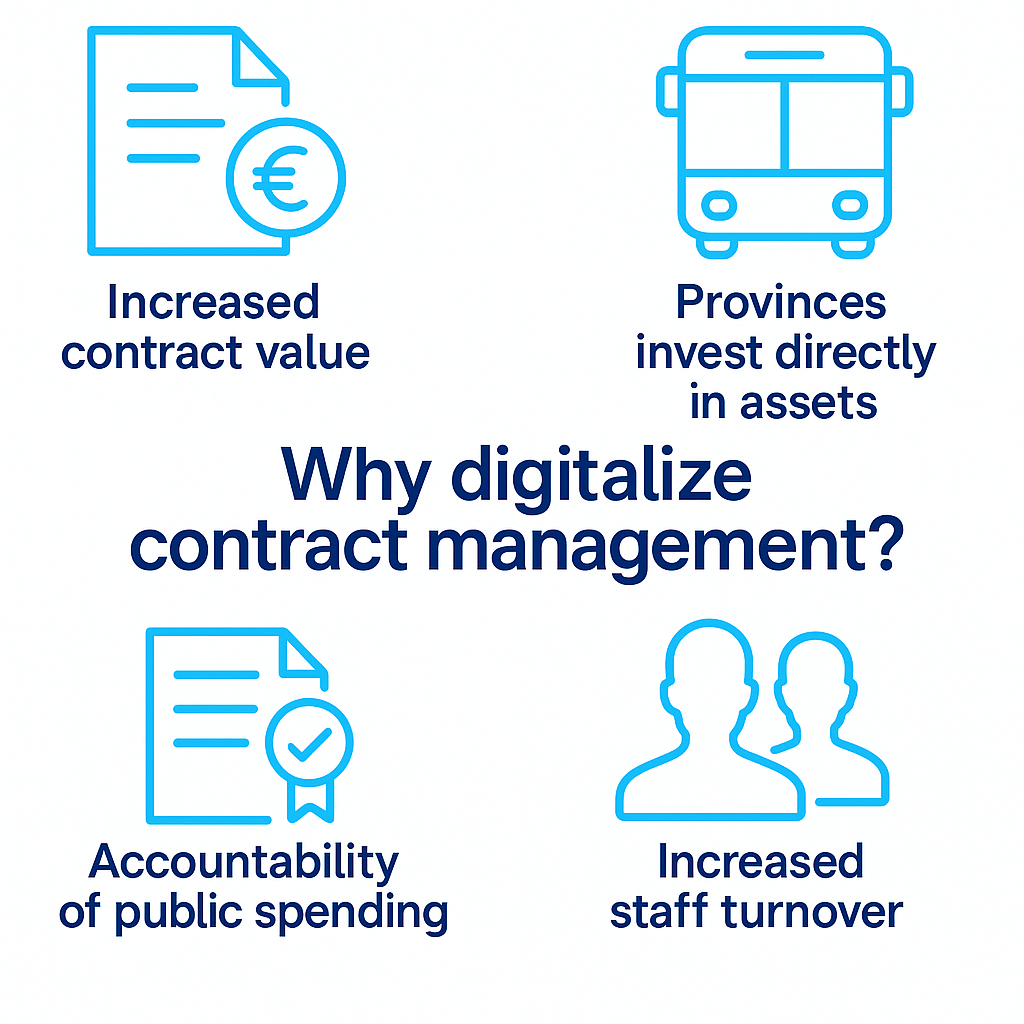
Auditors are increasingly requesting accountability for the efficiency and legality of subsidies and the performance of contracted service providers. This is especially important when mid-contract changes involve financial implications—proper documentation is essential.
"As concession managers, we need to operate in a similar way. Colleagues managing infrastructure construction and maintenance contracts have done this for years.”
— Concession manager (Dutch public authority)
With the introduction of zero-emission buses, more provinces are considering investing in vehicles themselves. This places new demands on contract management, including the ability to account for changes in asset value during the contract period.
The value of public transport concessions in the Netherlands has risen due to longer contract durations (often ten years) and the merging of concessions into larger units. As a result, concessions are now often held by a small number of mainly international transport companies.
These developments make it essential to professionalize concession management: stronger control over performance, risks, and agreements is critical.
Concession management is about long-term information management. Requests or objections from stakeholders may resurface years later—for example, in a new transport plan. Past agreements can become relevant again.
In the past, concession managers often stayed for decades and served as the “memory” of the concession. Today, with higher staff turnover, valuable knowledge becomes fragmented across documents and emails. Professionalisation helps preserve and make that knowledge accessible.
Public transport plays an important role in sustainability, urban accessibility, and giving people freedom of movement. Subsidies for these services are essential, as they cannot be offered profitably. Concession managers must ensure that public funds are used as effectively as possible to maximize their contribution to the well-being of citizens. After all, there are many social challenges—such as healthcare, sustainability, crime, economic development, and education. Every euro can only be spent once. In other words: the social benefits of subsidies provided for public transport must be comparable to the benefits achieved in other policy areas. There are clear opportunities to increase the efficiency of how public transport funds are used and to strengthen compliance through professional contract management.
Contract Management Tooling creates a single source of truth for all service contracts. This unified repository transforms public transport subsidy management. Here’s why:
By digitalizing contract management and creating a single source of truth, concession managers ensure each euro in public transport subsidies is tracked, transparent, legally compliant, and yields maximum societal value.
In the coming period, I will write about this based on real-world challenges faced by contract managers. We’ll also turn our blogs into videos, which you can find on our YouTube channel.
Would you like to contribute to the knowledge in this field or share a specific challenge? These are some of the topics we will cover:
Let me know if you want to keep informed or if you would like us to add a specific case.


